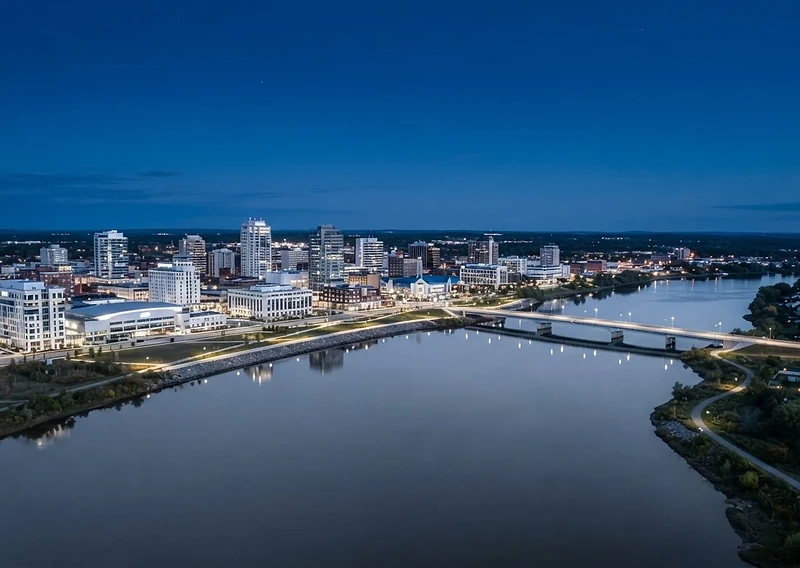
Moncton and Southeast
The Moncton region sits on sedimentary bedrock — mainly sandstone and shale — known to off-gas radon. Elevated levels have been documented across Southeastern New Brunswick.
How significant is the radon threat here?
Composite index derived from provincial geological surveys, uranium-bearing bedrock density, and documented homeowner test results.
Towns we serve in Moncton and Southeast
Our certified mitigation crews serve every community in this region. If your town isn't listed, we likely still cover it — request an estimate and we'll confirm.
The regional hub at the bend of the Petitcodiac, where sedimentary bedrock — sandstone and shale — lies just beneath the urban core. One in three homes tested here exceeds the action level.
Directly east across the river, sharing the same granite substrate but with tighter modern foundations that can concentrate radon if unmitigated.
Perched on the south bank of the Petitcodiac, where glacial till thins over bedrock and pressure differentials draw radon into hillside homes.
A coastal resort town northeast of Moncton where sandy overburden gives way to granite inland. Seasonal cottage conversions often lack the ventilation baseline testing requires.
A border university town on low-lying alluvial flats over granitic basement rock. The high water table and sealed basements create a notable radon risk profile.
A valley community south of Moncton, ringed by granite-cored ridges that channel radon-laden soil gas toward the low-lying center. Stone foundations here are especially vulnerable.
A highway corridor town northwest of Moncton on a transition zone between alluvial plains and deeper bedrock. Mixed soil conditions produce uneven but consistently elevated readings.
The bedrock beneath Moncton
Moncton and Southeast's radon potential is driven by its underlying sedimentary basin (sandstone & shale). Uranium trace deposits in the bedrock decay into radium, which in turn releases radon gas. This gas migrates upward through soil pores, foundation cracks, and construction joints into your home.
The 7 communities in this region share a similar geological substrate, but local variation in soil permeability, foundation age, and home ventilation can produce very different indoor radon readings — even between neighbouring houses.
Health Canada recommends every home test, regardless of region. But in Moncton and Southeast, testing is not optional — it's essential.
Mitigation in Moncton
- Sub-slab depressurization tailored to local bedrock conditions
- Single-day installation with minimal disruption to your home
- Post-installation verification to confirm radon below 200 Bq/m³
- Free no-obligation estimates for every property type
Protect your home in Moncton
Don't guess. Get a free, no-obligation estimate from New Brunswick's radon mitigation specialists. Same-week service available across Moncton and Southeast.
Get Your Free Estimate